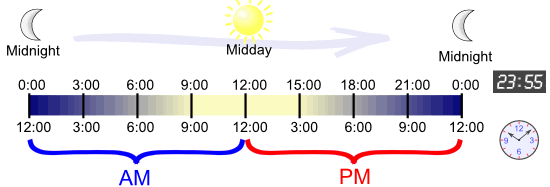
AM and PM are common abbreviations used in English to indicate the time of day. AM stands for "ante meridiem," which means "before noon," while PM stands for "post meridiem," which means "afternoon." These abbreviations are often used in digital and analog clocks, watches, and other timekeeping devices to distinguish between morning and afternoon/evening hours.
Origin of AM and PM
The use of AM and PM dates back to ancient Rome, where the day was divided into 12 hours. However, these hours were not fixed, and their duration varied depending on the time of year - longer in summer and shorter in winter. The first hour of the day was called "hora prima," which corresponded roughly to our modern 6 AM.
As the Roman Empire expanded, the use of the 12-hour clock spread to other parts of Europe and eventually to the rest of the world. However, it wasn't until the invention of mechanical clocks in the Middle Ages that the hours were standardized and given fixed lengths.
How to Use AM and PM

To use AM and PM, simply add the appropriate abbreviation after the hour when writing or speaking about a time. For example:
- 6 AM
- 3:30 PM
- 9:15 AM
- 10 PM
It's important to note that in the 12-hour clock, the day is divided into two 12-hour periods, rather than a continuous 24-hour cycle. This means that after 12 PM (noon), the hour count resets to 1, so 1 PM is actually the first hour of the afternoon/evening.
24-Hour Clock

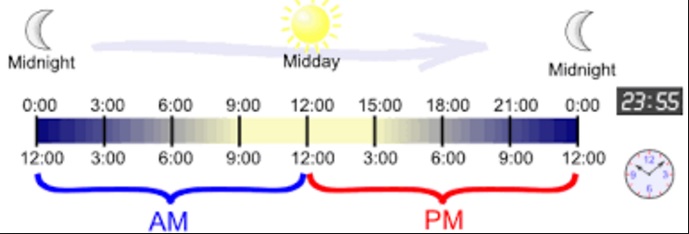
While the 12-hour clock is the most common way of telling time in English-speaking countries, other parts of the world use the 24-hour clock, which is also known as "military time." In this system, the hours are numbered from 0 to 23, with 0 representing midnight and 23 representing 11 PM.
The 24-hour clock is often used in transportation, healthcare, and other industries where precise timing is important. It eliminates the need for AM and PM and reduces the risk of confusion between morning and afternoon/evening hours.
Common Phrases with AM and PM
AM and PM are not just used to indicate the time of day - they also appear in a number of common phrases and idioms in English. Here are a few examples:
- AM radio - refers to the frequency range of radio stations that broadcast in the morning hours
- PMO - stands for "Project Management Office," a department within an organization responsible for overseeing projects
- AM/PM convenience store - a chain of convenience stores that are open 24 hours a day
- Prime Minister (PM) - the head of government in many countries, such as the United Kingdom, Canada, and Australia
Conclusion

AM and PM are simple yet essential components of the English language and are used by millions of people around the world every day to indicate the time of day. Whether you prefer the 12-hour clock or the 24-hour clock, understanding these abbreviations is crucial for effective communication in today's fast-paced world.