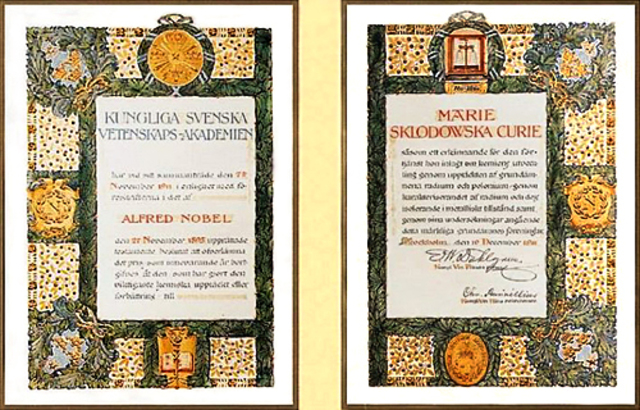
Marie Curie was a Polish-born French physicist and chemist who made groundbreaking discoveries in the field of radioactivity. She was the first woman to win a Nobel Prize and the first person to win two Nobel Prizes in different fields. Her second Nobel Prize was awarded for her work in chemistry.
Early Life and Education

Marie Curie was born Maria Sklodowska in Warsaw, Poland in 1867. Her parents were both teachers, and she was the youngest of five children. Her mother died when she was just 10 years old, and her father was unable to provide much financial support. Despite this, Marie was determined to pursue her education.
She attended a secret university in Warsaw, where she studied physics, chemistry, and mathematics. However, because women were not allowed to attend universities in Poland at the time, she was unable to receive a degree. In 1891, she moved to Paris to continue her studies.
Discovery of Radioactivity

In Paris, Marie met Pierre Curie, a physicist who shared her interest in radioactivity. The couple married in 1895 and began working together on the study of radioactivity. In 1898, they discovered two new elements, polonium and radium, which were highly radioactive.
The discovery of radioactivity revolutionized the field of physics and led to new advances in medicine and industry. Marie and Pierre were awarded the Nobel Prize in Physics in 1903 for their work on radioactivity.
Work in Chemistry

After Pierre's death in 1906, Marie continued to work in the field of radioactivity. She also began to focus on the study of the chemical properties of radium and its use in medicine. In 1911, she was awarded the Nobel Prize in Chemistry for her work on the isolation of pure radium and the discovery of its compounds.
Marie's work in chemistry paved the way for new advances in medicine, including the use of radiation therapy to treat cancer. She also established the Curie Institute in Paris, which continues to be a leading center for research in the field of nuclear physics and biophysics.
Legacy and Impact

Marie Curie's contributions to science and medicine have had a lasting impact on the world. She broke down barriers for women in science and inspired generations of scientists to continue her work. Her discoveries in radioactivity have led to new advances in medicine and industry, and her legacy continues to be felt today.
In addition to her two Nobel Prizes, Marie was the first woman to become a professor at the University of Paris and the first woman to be entombed on her own merits in the Panthéon in Paris. Her life and work continue to inspire and educate people around the world.
Conclusion
Marie Curie was a true pioneer in the field of science and an inspiration to all who aspire to make a difference in the world. Her second Nobel Prize in chemistry recognized her groundbreaking work in the study of radioactivity, which has had a profound impact on the world of medicine and industry. Marie's legacy continues to be felt today, and she remains a role model for women in science and beyond.